
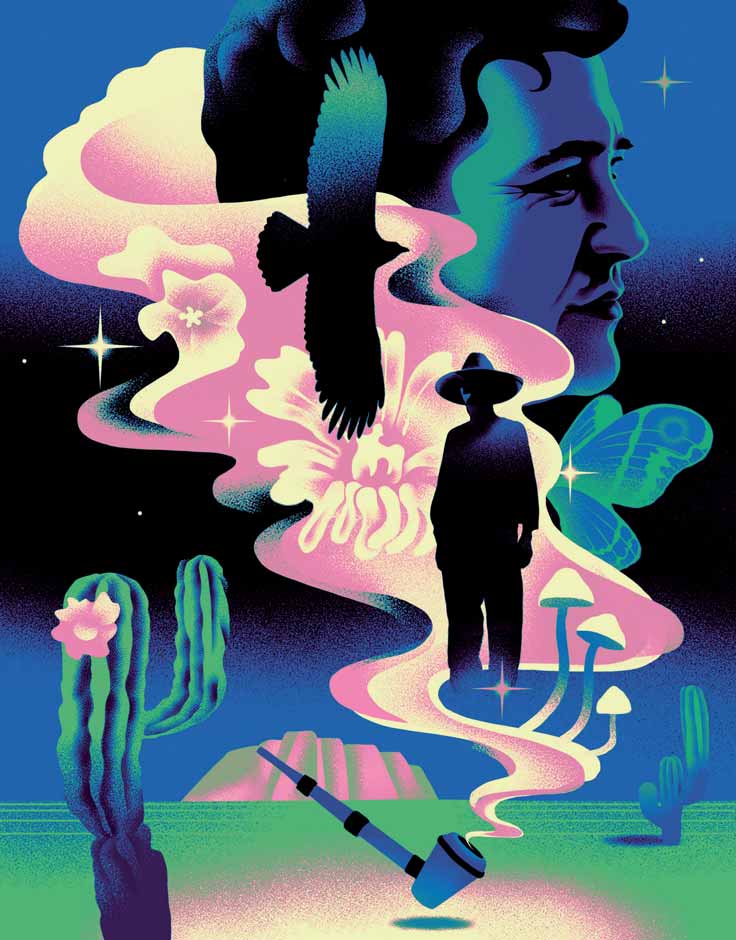
Carlos Castaneda was, for a time, the world’s most famous anthropologist. In his first book, published in 1968 while he was a mature graduate student at UCLA, he detailed his apprenticeship with an indigenous Mexican shaman named Don Juan, who opened his mind to non-Western ways of knowledge. It was an immediate bestseller, and more books followed. Hippies and beatniks lapped it up. William Burroughs, John Lennon and Bob Dylan were fans. The only problem was that it was all made up. Don Juan never existed.
Castaneda was a compulsive liar, a fabulist, a plagiarist, a virtuoso bullshitter. He lied about his age, his birthplace, his family and his work; he lied in his will. Latterly, he became a cult leader, possibly responsible for several deaths. The question posed by this exhaustive, and exhausting, biography is: how much do we really need or want to know about such a toxic and, in the end, intellectually nugatory figure?
He was born César Arana in 1925 in Cajamarca, Peru, to middle-class parents who were secretly members of an underground social-justice movement. At the age of 19, he got drunk with his friends on Christmas Eve before attending midnight mass with his family: he threw up in the cathedral. The next day his appalled father packed him off to a posh finishing school in Lima, and César never saw his home town again. At the age of 24, he got a local 13-year-old girl pregnant, so he skipped town, getting on a boat he told friends was bound for Brazil but actually decanted him in San Francisco.
Now calling himself Carlos Castaneda (his grandfather had been Carlos Castañeda; he simplified the orthography to make it easier for the gringos), he enrolled at Los Angeles City College to study psychology, and later transferred to the anthropology department at UCLA. This, in Ru Marshall’s telling, is where he encountered the radical relativism that then held sway in the discipline, and began plotting what the author suggests might have been primarily an epic practical joke with his teachers as the target. “He sought to be accepted in the world of ideas – by men of ideas,” Marshall writes. “And to vanquish and mock them.”
The primary mark, if that is the case, was Harold Garfinkel, the founder of “ethnomethodology”, an approach holding that social and knowledge-producing institutions are always in the process of being created through people’s interactions, rather than obeying any top-down rational order. He was renowned around campus for recruiting students into his “breaching experiments”, according to which the arbitrary nature of social conventions could be uncovered by people deliberately behaving very strangely. In one such experiment, Marshall explains, “students knocked on the door of a stranger’s house, explaining they needed to come inside so they could knock on another door in the house”. In another they engaged in ordinary conversations but pretended not to understand anything their interlocutor said.
These vaguely situationist jokes often left the unwilling subjects confused or traumatised, but for their perpetrators the breaching experiments demonstrated a profound truth, put this way by another professor in Garfinkel’s orbit: “In ethnomethodology, the existence of any orderly world is, in some sense, a fiction.” Well, then: if everything is a fiction, why should one not publish one’s fiction about an imaginary sorcerer as though it were true? Castaneda brought the manuscript of The Teachings of Don Juan: A Yaqui Way of Knowledge to his teachers and they were bowled over, contributing an admiring foreword to the book. In publishing it he demonstrated that there was no orderly means of testing empirical claims made within the discipline. “The Don Juan books,” Marshall argues, were really “an enormous breaching experiment” directed against the experimenters themselves.
It is an ingenious (and maximally charitable) line for the author to take, though it should be noted that the hoaxer differs from the fraudster in that the former usually confesses his untruths. Castaneda never did, even as sceptical voices gradually emerged in the ensuing years. One expert on Yaqui drug rituals pointedly asked Castaneda exactly what kind of mushrooms Don Juan ground into powder and smoked, since as far as he knew magic shrooms were always eaten. In 1972, Joyce Carol Oates wrote to the New York Times doubting that it was “possible that these books are non-fiction”. In 1973, Time ran a sceptical profile, quoting the anthropologist Francis Hsu: “Castaneda is a new fad. I enjoyed the books in the same way that I enjoy Gulliver’s Travels.” The case was proved beyond all doubt by the 1976 exposé Castaneda’s Journey, written by Richard de Mille, son of Cecil B DeMille, who himself had escaped the clutches of Scientology.
It was obvious, then, to informed observers by the mid-1970s that Castaneda was a charlatan and a giant phony; amazingly, nothing really happened. The early books carried on being reprinted and new ones continued to be published. Joni Mitchell released an album called Don Juan’s Reckless Daughter in 1977. Raiding the myth-kitty for Star Wars, George Lucas based the character of Obi-Wan Kenobi – another wise man with magical powers – on Don Juan. Oliver Stone and Federico Fellini sought Castaneda out in the 1980s.
But then the books – with their message that Westerners were cut off from more authentic ways of experiencing and knowing the world by their enslavement to rationality and conventional morals – were catnip to the late-1960s counterculture. Don Juan did not exist, so it became necessary to invent him. A persuasive case is here made, indeed, for the literary qualities of the first book at least: The Teachings of Don Juan,Marshall argues, is “compelling, disturbing, uncanny”; it “has the best ghost stories’ capacity to unnerve”. I was struck by a line from its sequel, Journey to Ixtlan: “For an instant,” the character of Carlos reports in the book, “I think I saw. I saw the loneliness of man as a gigantic wave which had been frozen in front of me.” Marshall does a forensic job of teasing out Castaneda’s literary influences (Nietzsche and Sartre primary among them) and also the anthropological texts he straight-up plagiarised, concluding that his subject was at least a kind of genius of the mash-up: “Anyone can steal. Few can steal with Castaneda’s skill and aplomb, fewer still can then brilliantly combine their thefts.”
There is less – actually, nothing – to be said, on the other hand, in favour of Castaneda’s extra-literary activities. He began to gather a harem of “witches” through the inventive means of telling women that his semen had magical powers. He taught a confected system of physical movements called tensegrity, which he claimed to have learned from a kung-fu master who was 1,000 years old. (People paid good money to study it at workshops.) He had sex with his adopted daughter and told another woman she should see her naked. He instructed his followers to sleep with one another in combinations of his choosing. By the 1990s he was telling disciples that Hitler was a big influence on his life, and that if they were depressed or nervous they should eat ants. Former followers say he once cured a baby’s colic, knew things he shouldn’t have been able to, and put a hex on someone that manifested in stabbing needle-like pains. “Once he’d cut a woman’s hair,” Marshall reports, “no one else was allowed to.”
In 1998, after months of watching war movies while bedridden on a morphine drip, Castaneda died of liver cancer. His final words conveyed no apparent mystical wisdom. Instead, he said: “Who’s the asshole who bought this stupid fucking video?” and expired. But his legend lived on. Marshall talks to several former disciples, none of whom is able to reject him completely and many of whom believe that he may have had actual powers of sorcery. This will seem unlikely to most readers. One of his witches, we learn, once told novitiates that Castaneda didn’t need to read in the ordinary way any more; he read books by absorbing them through his legs while asleep. How, you keep wondering, did people swallow this crap?
The author is very interesting on the counterintuitive psychological dynamics of cults, or what he alternatively calls “high-control groups” or “high-demand groups”, and admirably sympathetic to their members. “Stereotypes of high-demand group members as weird and weak-minded,” Marshall notes, “serve to keep people in these groups.” Even when, as it gradually became clear, Castaneda’s group was potentially transforming into a Heaven’s Gate-style suicide cult. The sociopathic leader began talking about taking the group with him, to escape to another reality: making what he called “the leap”. After his death several of his women followers disappeared, never to be heard from again. Years later the bleached bones of Nury, his adoptive daughter, were found in the desert.
As the story darkens and Castaneda’s sociopathy devolves into flat-out madness in the 1990s, this book slows down in order to document seemingly every micro-interaction between the cult members from one week to the next. Marshall’s extensive interviews with the survivors render this material distressingly credible but, at some point, no less tedious: an afterword mentions that a previous publisher demanded the author cut another 50,000 words, which seems about right. Happily, after a 100-page slog of increasingly bleak soap opera, the book ends with a return to the author’s incisive and intelligent analytical style, as we approach the larger questions of how Castaneda’s life might be a symptom of wider cultural and social trends.
What really drove Castaneda? Persuasive evidence is offered that he might have been a direct descendant of one Julio César Arana, “perhaps America’s most brutal 20th-century génocidaire”, who tortured and murdered his indigenous workers as head of the Peruvian Amazon Rubber Company. (In the early 1910s these atrocities were investigated on behalf of the British government by Roger Casement, the diplomat later turned Irish nationalist, who had also uncovered the brutality of the Belgian Congo.) If, as Marshall argues, Castaneda knew about this horrific stain on his family, his actions might have been driven by “perpetrator trauma”.
And in the end, perhaps we all secretly admire a successful trickster. Marshall speaks of “the pleasure we feel when the conman arrives”, which is probably not irrelevant to the magnitude of, say, Donald Trump’s following. The thirst to be assured that any scientific or social consensus is wrong, too, persists, in the internet-enabled efflorescence of conspiracy theories. Meanwhile, Castaneda’s The Teachings of Don Juan is still advertised on the website of University of California Press, which reproduces the early rave reviews while claiming carefully that “whether read as ethnographical fact or creative fiction”, it remains a “classic”. “His books,” the author bio notes, “continue to inspire and influence both new readers and dedicated fans.”
Steven Poole’s books include Unspeak (Little, Brown) and Rethink (Cornerstone)
American Trickster: The Hidden Lives of Carlos Castaneda
Ru Marshall
OR Books, 682pp, £21.99
[Further reading: How good is Colson Whitehead?]