
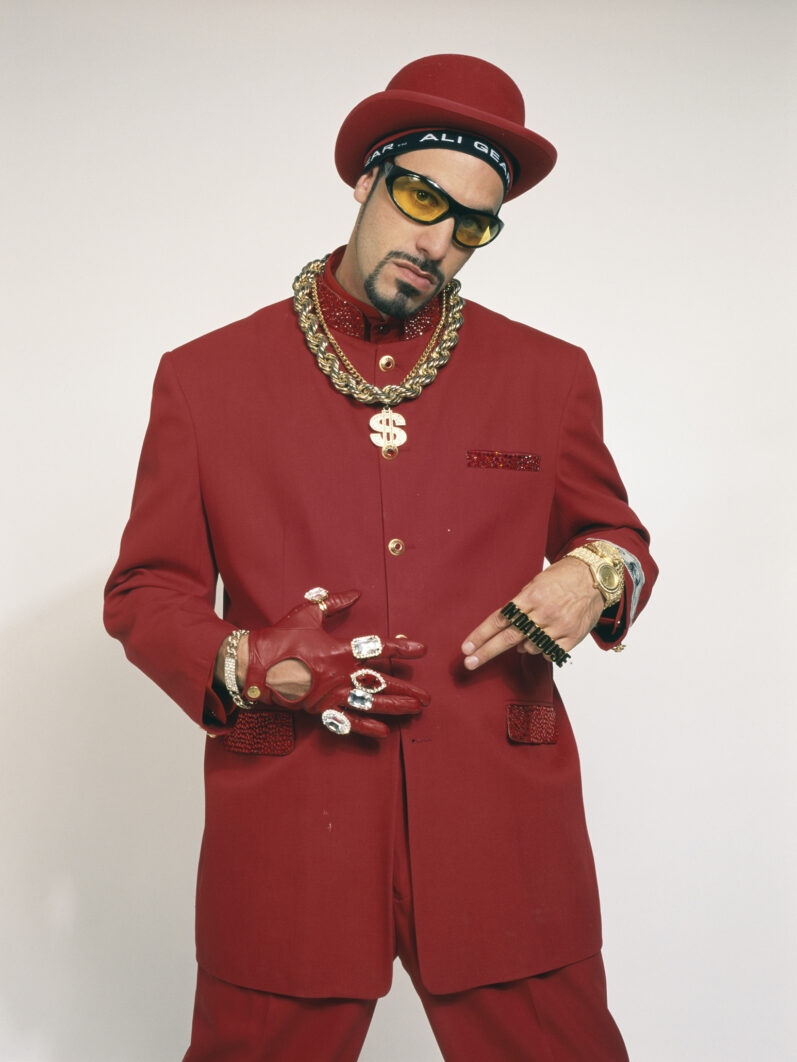
One important lesson from the Peter Mandelson scandal: bringing back colourful characters from the Blair years is not always the big-brain move you think it is. Yet Amazon MGM Studios is not content to learn from Keir Starmer’s mistake. In October, it will release Ali G: Who Iz I? Sacha Baron Cohen’s suburban wannabe gangster, the rudeboy-aspiring leader of the West Staines Massiv, will return – has returned, in fact. Baron Cohen appeared in character at the Wimbledon men’s singles final earlier this month, posting a front-camera Instagram monologue about dealing weed: “Them say that tennis is better played on grass, which is why I intend to sell as much of it while I iz here.”
The costume was familiar and unchanged: fake goatee, beanie, tinted yellow sunglasses and tracksuit. Also the patois-inflected Multicultural London English accent, which intermittently veers back into Baron Cohen’s own upper-middle-class drawl. Perhaps less of the edge, this time round. Attending a premier sporting fixture is not quite the same as doing gonzo ambush interviews with Donald Trump and Noam Chomsky. Baron Cohen is a regular celebrity out of costume now; the day before his stunt, he went to Wimbledon as himself.
Ali G was the first of his characters that got big, and it never quite had the shock value of Borat (wearing a “mankini”; leading crowds of Americans in anti-Semitic chants) or the gay Austrian fashionista Brüno (planting his arse on Eminem’s face at the 2009 MTV Movie Awards; being chased out of a Hasidic neighbourhood in Jerusalem for wearing a skimpy version of ultra-Orthodox dress). But it was the one that said the most about its creator. The humour of Ali G always depended on a clever, cruel sleight of hand. Ostensibly, we were laughing at the spectacle of a suburban white guy called Alistair Leslie Graham hopelessly trying to imitate black culture. “The point is that it is not attempting to be an imitation of a black person, it satirises white men trying to adopt black street culture,” a Channel 4 spokesman told The Guardian in 2000.
In fact, most people were laughing directly at the minstrel-esque version of that culture Baron Cohen was presenting. Could this have been a loving parody borne of proximity? Probably not. Ali G’s creator attended Haberdashers’ Boys’ School, a posh private school in Hertfordshire, and Christ’s College, Cambridge. His brother and three of his cousins are esteemed enough to have their own Wikipedia pages. In a New Labour dreamland that was officially becoming more equal and tolerant, programmes like Da Ali G Show and Little Britain allowed cultural elites to maintain hierarchies and kick rigorously downwards with the plausible deniability of satire. When Ali interviewed a young Jacob Rees-Mogg in 1999, we were essentially treated to two Oxbridge graduates discussing class. Not exactly a thrilling novelty in British cultural discourse.
Who Iz I?, the title of Baron Cohen’s new film asks. Well, who is Ali G in 2026, and who is he for? He is certainly untethered from any socioeconomic reality: the premise of a (young) white man appropriating “black street culture”, as Channel 4 put it, is now fairly unremarkable given how influential and mainstream that culture has become. Channel 4 is no longer satirising rappers but giving them chat shows: Big Narstie got five series for his. Anyone under 21 living in a big city speaks some degree of MLE, no matter how expensive their school is.
Some of the current students at Baron Cohen’s old Cambridge college could feasibly be there thanks to a scholarship set up by another rapper, Stormzy, who was himself given an honorary fellowship by Jesus College last year. Ali G falls flat not because (or not just because) of modern “woke” attitudes to race, but because the thing he mocked is no longer low status. Most modern television commissioners likely listen to rap and own a bit of streetwear themselves.
So maybe Ali G can get himself cancelled by the left and get some clout with the right? Wrong. Ali G is not a joke to the modern right, but a goading symbol of the liberal mainstream’s hypocrisy – how they mocked the very thing they were using their political power to spread via loose migration policy. A man from Staines wearing a tracksuit and speaking in Jamaican slang is an omen of catastrophe rather than a bit of fun, and bringing the character back now is a symptom of delusion about Britain’s supposed ethnic disharmony: if only Ali G were all we had to worry about rather than the incoming race war. The humour of Baron Cohen’s character, such as it was, came from him being out of place – why is this clueless lout interviewing such-and-such a politician? That placelessness is far more fundamental this time around, and far less funny.
[Further reading: Music, Fashion, Film is Charli xcx at her subversive best]