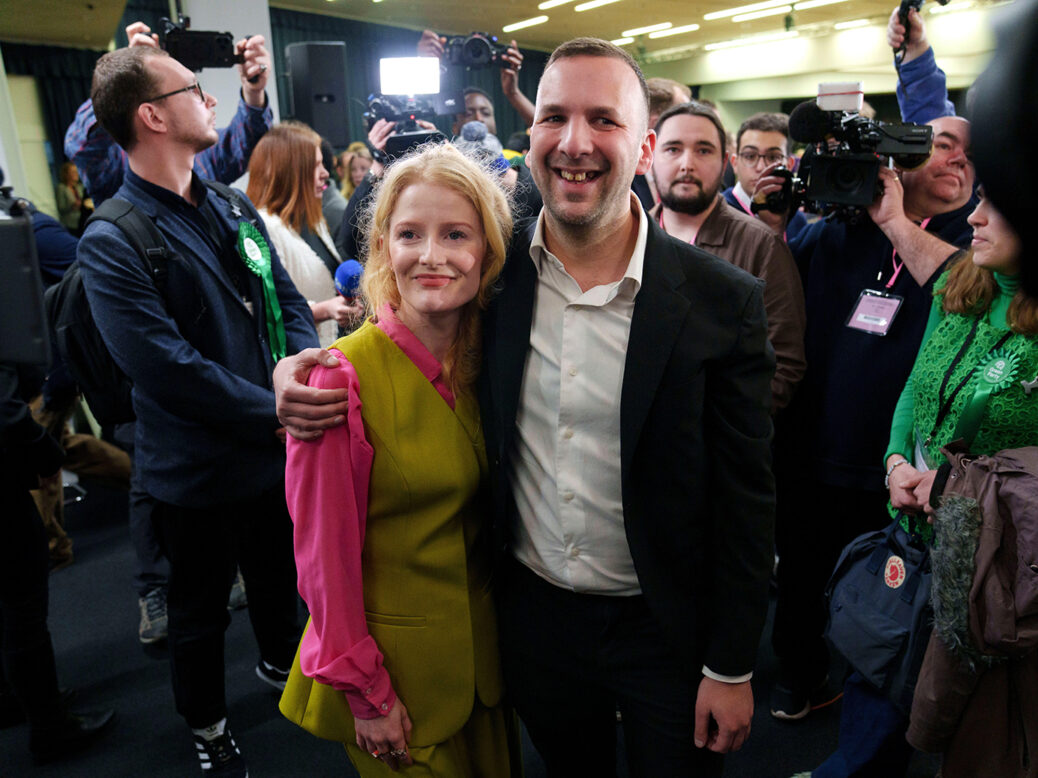
The Greens have scored a shock win over the incumbent Labour Party in the Gorton and Denton by-election. Hannah Spencer, the Green candidate, won with 14,980 votes, defeating Reform’s Matt Goodwin on 10,578. Angeliki Stogia, the “fall guy” Labour candidate for the Starmer blunder of blocking Andy Burnham, won just 9,364 votes.
The Greens have secured the seat by a margin over and above anything a forecaster could have reasonably predicted.
This result represents one of the greatest calamities to hit the Labour Party for more than a generation. The Green Party is a large, viable, organised electoral vehicle that aims to replace Labour at the polls. Whether it can repeat this success at the next by-election, with a less friendly voter demographic, is yet to be seen. But it is no longer a fringe force. The Greens are here to stay.
The implications for this by-election loss could not be more severe for Labour. It says to the one in three current Labour voters also giving thought to switching that a Green vote is no longer a wasted vote. It may cause a polling upsurge that would upend Labour as the second or third most popular party in the country. It could push Labour to fourth, and the Greens to third. Or second.
Practically, it could amount to a four percentage point transfer from Labour to Green in the polls. Possible gains in May, in London and urban northern England, as well as Wales and Scotland, would embed the feeling that the Labour Party is no longer the pre-eminent party of the left.
This may sound a little existential but it’s not without cause. That so many of the Labour base dispensed with its party in one of its safer seats means anything is possible.
All of this, I have to say, was totally avoidable for Labour.
The decision by the party’s ruling National Executive (NEC), at the behest of Keir Starmer and Morgan McSweeney, to bar Burnham, the mayor of Greater Manchester, from being eligible to stand for the Gorton and Denton seat – which is in Greater Manchester – was a calculation to save their own skin. Burnham is popular with the rank and file. A majority of members want him to be Labour leader.
The reason given for the NEC’s Burnham block – that Labour couldn’t risk the Greater Manchester mayoralty falling to Reform – also fails to stand up to scrutiny. Voters demonstrated in Gorton and Denton their willingness to find the best vehicle to contain Reform. In elections, such as mayoral ones, where candidates receive second-preference votes, fears about a Reform victory ring statistically hollow at best – or wilfully naive at worst.
In response, voters rejected Starmer’s Labour. And for the councillors and parliamentarians in marginal and Green-friendly seats, that decision may prove fatal.
Brand Burnham does miles better than Labour among Conservative, Green and Reform voters. Knowing almost half of those that vote Green nationally look upon the Manchester mayor favourably will likely be a sore point for beleaguered Labour campaigners after a gruelling and, occasionally, abusive election campaign.
The death rattle for Starmer’s Labour is coming not just from the right, in the Durhams and Doncasters of the world, but also on the left, in the Lancasters and Longsights. As one councillor intoned to me in the early hours: “No candidate or campaign can undo how we are governing.”
[Further reading: Green Party takes Gorton and Denton, pushing Labour to third]
Content from our partners


Related