
When disorderly apprentices rioted in Southwark in the summer of 1592, the authorities were quick to close down what seemed a principal encouragement to unruliness: theatres. An order was issued that they stay dark until October, but any hope of their reopening on schedule was scuppered by the outbreak of plague. In the interests of public health, they would remain shut, with brief intermissions, until June 1594. London theatre companies enterprisingly transformed themselves into touring troupes and headed for the provinces.
Young Shakespeare, just establishing himself as a playwright with a trilogy about Henry VI, found himself similarly obliged to try something different while normal business was suspended. His bright idea was to publish a verse narrative. Venus and Adonis appeared in April 1593, in a handsomely printed volume. It did very well; at least 16 editions appeared by 1640. In the 21st century it even found its way into the theatre: Greg Doran’s puppet-led production, narrated by Simon Russell Beale, is at the Barbican this month.
The poem originally had no tradition of being staged; indeed, it was because of Venus and Adonis that Shakespeare’s celebrity would for some years not be primarily as a dramatist but as a poet. “I’ll worship sweet Mr Shakespeare,” says a fop in a student revue performed in Cambridge in the late 1590s, “and to honour him will lay his Venus and Adonis under my pillow.”
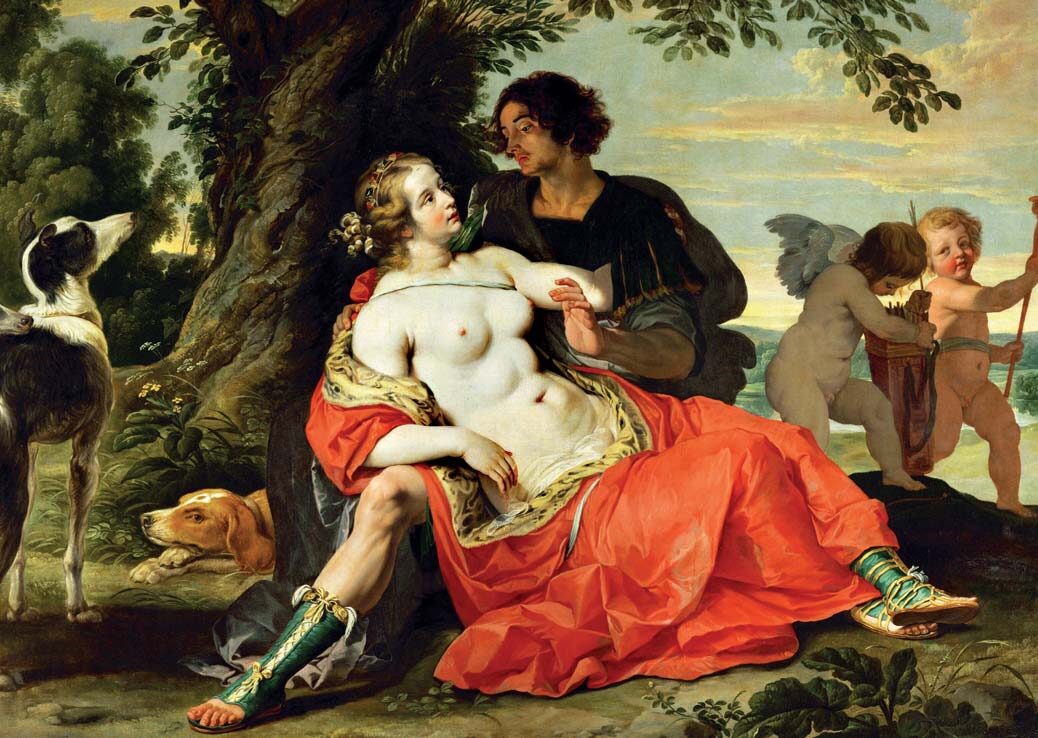
The joke in there was partly at the expense of a contemporary literary fashion. Shakespeare, obviously keen to make his mark in the modish genre of narrative poetry, had taken his plot from Ovid’s Metamorphoses, a 15-piece set of stories full of sex, violence and magical transformations then popular as a sourcebook among stylish young wits. In Book 10, Ovid recounts the tale of Venus, goddess of love, who, punctured by Cupid’s arrow, falls in love with the unparalleled beauty of the boyish Adonis. “She loved Adonis more/Than heaven”, as Arthur Golding puts it in the translation Shakespeare would have known. She clings to him. But being his constant companion turns out to be easier said than done; Adonis is a keen huntsman and, while Venus is untroubled when he goes after hares, she frets about larger quarry such as boars: “Wherefore I pray thee, my sweet boy”, she tells him, “forbear too bold to be.” As might be predicted, his bold heart spurns such prudent advice and he enthusiastically pursues the next available boar – which duly charges him and he is killed. A heartbroken Venus, lamenting over his lovely body, conjures the young man into a flower, whose annual appearance shall be his lasting natural memorial.
Shakespeare’s brilliant twist to this familiar story was to imagine an Adonis quite untouched by the advances of the goddess who “cannot choose but love”. By a stroke of comic invention, this young man is physically dazzling but basically gormless: “‘I know not love’, quoth he, ‘nor will I know it,/Unless it be a boar, and then I chase it’”. The main business of the poem is Venus’s protracted attempt to get any sort of response out of him apart from indifference or embarrassment. She is impressively committed to the task, plucking Adonis bodily from his horse at one point, and smothering him with kisses; but her most striking efforts are rhetorical. She tempts him with “honey secrets”, she reproaches him for being flint-hearted, she begs his pity, she counsels him to seize the moment, she proffers procreation as a moral obligation – to no avail. Through it all, Adonis sits in uncomprehending silence: “Nay then… you will fall again/Into your idle over-handled theme”, he complains when Venus seems about to launch on a new salvo of eloquence, as though to say, “You don’t half go on.”
The sustaining joke of the poem is the comedy of its wonderful articulacy. As Colin Burrow puts it in his excellent introduction to The Complete Sonnets and Poems for The Oxford Shakespeare, Adonis keeps trying to bring the poem to a close so he can get on with something more interesting like hunting, but the poem keeps having other ideas. Nevertheless, at one point – rather like a character in a Shakespeare play discovering an inwardness that we hadn’t suspected – this remorseless youth rises to a genuinely touching moment when he apologises for being simply out of his depth: “Measure my strangeness with my unripe years”, he pleads to the goddess of love, who isn’t listening, “Before I know myself, seek not to know me”.
He finally slips away and, as in Ovid, he is duly gored, and the collusive comedy of verbal inventiveness in which the reader has participated is at once shattered. Venus’s agony is more protracted in Shakespeare’s version: she convinces herself that she has heard the voice of Adonis, but then she sees his body and realises her mistake. Her eyes, appalled at what they have confirmed, withdraw into her head. Finding the right simile to describe this inspires one of the most dazzling and sympathetic imaginative acts in the poem:
Or as the snail, whose tender horns being hit,
Shrinks backwards in his shelly cave with pain,
And there all smother’d up, in shade doth sit,
Long after fearing to creep forth again
When Coleridge listed the features that constituted the poem’s greatness, one of them was “that affectionate love of nature and natural objects, without which no man could have observed so steadily, or painted so truly and passionately, the very minutest beauties of the external world”, something which the marvellous snail exemplifies superbly – as does Coleridge’s own favourite example, the description of Adonis finally escaping Venus’s clutches: “Look how a bright star shooteth from the sky/So glides he in the night from Venus’ eye”. But the poem ends on a subdued note, as though such invention were spent. In Ovid, Venus acts purposefully in conjuring the boy into a flower, but Shakespeare describes a depleted figure, much less the author of the terms of her own mourning: “the boy that by her side lay kill’d/Was melted like a vapour from her sight”.
In his extraordinary account of the poem, the poet Ted Hughes discerned a battle between an ancient female nature religion and the chilly new men of the Reformation who resist her prehistoric advances: the poem enacted a pervasive civil war taking place within the English mind of the time. Venus fails to seduce Adonis back into the arms of paganism, but he pays the price as the old natural energies he has sought to suppress arise (in the shape of a boar) and kill him off. It is an idiosyncratic reading to be sure: for a start, Adonis comes across as an odd sort of Puritan. Still, Hughes does get at something of the poem’s profound implication in a world torn by intermingling energies of destruction and desire. “Had I been tooth’d like him”, says a bereft Venus, contemplating the murderous boar, “I must confess,/With kissing him I should have kill’d him first”: how deftly Shakespeare has her get her two “hims” crossed.
Hughes’s conflictual account misses the vulnerability that the poem depicts so touchingly, and which it repeatedly finds particularised in the natural world. At one point, Venus sets out to advocate the advantages of hare hunting only to find herself, as she does so, suddenly caught up in a life of danger, when the poor animal, “far off, upon a hill,/Stands on his hinder legs with listening ear,/To hearken if his foes pursue him still.” Like the great comedies Shakespeare would write once theatres reopened, the poem is boisterous and ebullient but always mindful of the possibility of harm.
Seamus Perry is master-elect of Balliol College, Oxford. Greg Doran: Venus & Adonis is at the Pit theatre at the Barbican, London EC2, until 27 June
[Further reading: The myth of English insularity]
Content from our partners


Related


This article appears in the 17 Jun 2026 issue of the New Statesman, The Race