
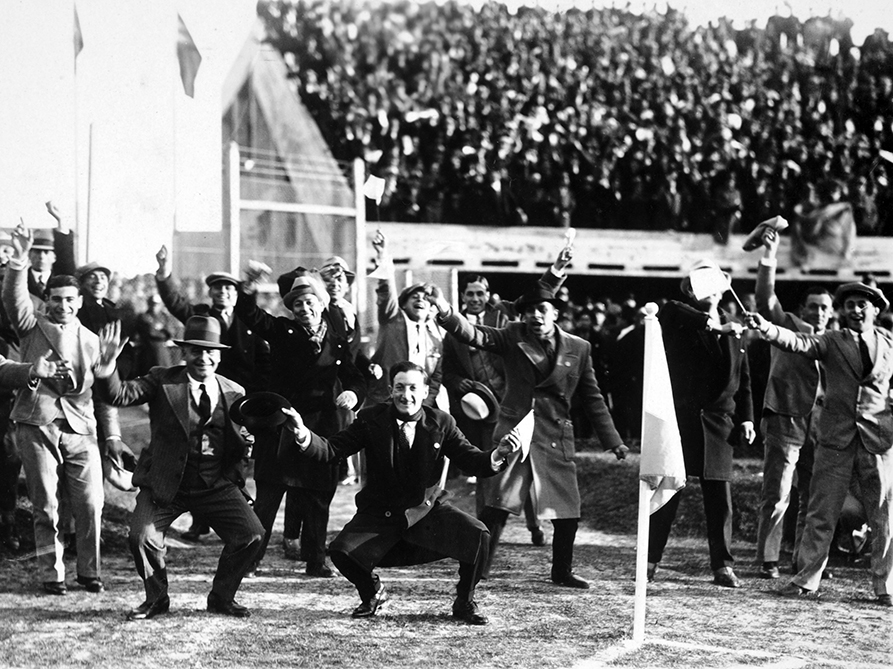
The World Cup has become our greatest international festival: a carnival of communal viewing, a cosmopolitan dream space where, for a month or so, the world’s routines are altered around football, and we glimpse our universal humanity through a now universal game. Yet it is also a competition between nations, whose teams are among the most powerful spaces for inventing and representing those nations, and not always benignly. As Eric Hobsbawm observed, “The imagined community of millions seems more real as a team of 11 named people.” Occasionally, football matches become a symbolic recreation of real enmities, historical and current – how else can we read Argentina vs England at the 1986 World Cup, or any England-Scotland game?
At one level, this shouldn’t be a problem: one can feel both cosmopolitan and fiercely nationalistic about who one supports – everyone, after all, has their second team. But at this year’s World Cup, the contradictions feel sharper, the pantomime uglier. Its main host, the US, is run by an administration that has systematically attacked what was left of the international regimes created after the Second World War. It has made its contempt for international law, courts, treaties and alliances clear, and has terminated, with deadly consequences, its entire international aid programme. Uniquely, in the history of the tournament, the host nation will welcome the team of a nation, Iran, that it is at war with. Under the right circumstances they could even play each other in the knockout stages.
Fifa has created rules for national football citizenship that give players the option of playing for their own birth nation, nations whose citizenship they have acquired, or that of any one of their grandparents. By contrast, the White House has been responsible for some of the most incendiary anti-immigration rhetoric in the world, attempted by means of law and coercion to close its Mexican border, and sharply restricted access to US visas for the rest of the world. This has had real consequences for the World Cup.
It is impossible under current circumstances for citizens of four of the qualified nations (Côte d’Ivoire, Haiti, Iran, Senegal) – World Cup squads aside – to get any kind of visa at all. Nationals of another dozen or so are required to pay large bonds to the US embassy before travelling, though this has been suspended for players and official ticketholders. Even so, the dismal state of US embassies in much of the Global South makes the chance of getting a visa slim, even with a ticket. By contrast, in Russia in 2018 and Qatar in 2022, a World Cup ticket served as a visa. More worrying, perhaps, is the possibility of Ice agents being deployed to stadiums during the competition – a threat to workers and fans alike.
While America’s ruling regime articulates an increasingly exclusionary and nativist version of national identity, international football squads present an extraordinary tableau of the many different recipes for creating nations. They are evidence that the world, like it or not, has already been remade by the greatest burst of international migration in history.
In an academic paper published in May, researchers from the University of Georgia in the US looked at the composition of squads at three World Cups: 1930, 1986 and 2022. Players’ ethnicity and birthplace were recorded and teams placed in one of four categories – ethnic, civic, diaspora and cosmopolitan – each corresponding to a different kind of nation. Ethnic teams were those composed overwhelmingly of players who were born in that nation. At least a third of players for civic teams were foreign born, or domestically born to a parent who had migrated to the country. For diaspora teams, at least a third of players were born outside the nation, but were part of its dominant ethnic national groups. Finally, at least a third of players in cosmopolitan teams were born abroad with no birth links to the nation they play for.
The authors found that at the first World Cup, held in Uruguay in 1930, 11 of the 13 competing nations fielded ethnic squads, one a civic team – Romania, with a mix of Romanians, Hungarians, Jews and Germans – and one, the US, was cosmopolitan. Very little had changed by 1986, when, of the 24 nations that qualified, 22 were represented by ethnic squads and just two, France and Canada, could be considered civic teams. That period was, by historical standards, an era of relatively low international migration. By 2022, however, the now expanded tournament of 32 nations had 19 ethnic teams, seven civic, five diaspora and one cosmopolitan.
Adapting this work to do a similar count of the official squads for the 2026 World Cup confirms the obvious: global migration continues apace, and in so doing is transforming the character of nations and national cultures. Of the 48 nations competing, 19 are fielding teams the researchers would consider ethnic – the first time they have not been a majority. But perhaps the biggest change is the number of diaspora teams: now 14, nearly a third of the total. Qatar is again the sole cosmopolitan.
The ethnic squads are themselves very heterogeneous. Four are from rich countries that have had relatively low levels of migration. Japan and South Korea have actively discouraged it, and in both cases have just one player born abroad or of mixed heritage out of their 26. Scotland and Czechia have been more welcoming to migrants, but neither has been economically successful enough to establish the immigrant football cultures that blossom elsewhere in Europe.
Saudi Arabia, by contrast, is a rich nation that has experienced gigantic levels of labour migration over the past 20 years, but where there is no route to permanent residence or citizenship for any of them, least of all to play for the national football team. Qatar – the one cosmopolitan team – has followed a similar path, but did create a route to naturalisation for football players via its global scouting networks. Three of the ethnic football nations are less economically developed countries: Egypt, South Africa and Uzbekistan. While Uzbekistan has had very little immigration recently, Egypt and South Africa have received enormous numbers of migrants – but nearly all of them are either refugees or undocumented. Either way, there is no route, as yet, from the townships, shack cities and migrant camps to football citizenship. South Africa also presents problems with the conventional idea of the ethnic nation, as players are drawn from the many different precolonial societies of the region. The same is true of a notionally ethnic team such as Iran’s, which draws on a population that is the product of an enormously long process of migration and state formation – it is in fact the most diverse team at the tournament.
The civic squads at this World Cup now make up 30 per cent of the total. The most diverse are France (fielding 22 players with migrant roots), England (16), the Netherlands (15), and Belgium (ten); they are a testament to the power of football to mobilise and reward talent and graft. These civic teams are joined by Austria, Germany, Switzerland and Sweden, all of which have taken in significant numbers of economic migrants and refugees. Four other nations – Norway, Portugal and Spain – whose major labour migrations are very recent, are shifting from fielding very ethnic to part-civic squads. This is our world revealed to us: a world of Ghanaian Spaniards and Gambian Norwegians.
In Europe, international football has served as the public theatre of the politics of national identity. At times, it has been a space for crude bigotry and racism. When Mario Balotelli was playing, the Italian fans would chant, “A negro cannot be Italian.” Politicians make the same point in more coded language: Jean-Marie Le Pen, founder of the far-right party National Front, repeatedly questioned the “Frenchness” of the team and its players. His successors continue to do so. The conditional nature of minority membership of the nation has been an ever-present trope. The Belgium striker Romelu Lukaku wrote that when he was on the up, the press called him “the Belgian striker”, but when his form dipped they called him “the Belgian striker of Congolese descent”. At the same time, international football has offered the most fabulous challenges to them: the utopian moment of “Black, Blanc, Beur” when France’s super-diverse team won the 1998 World Cup; Ian Wright heroically singing the national anthem, acapella, when England’s hosts lost the recording and his white peers their voices.
The result of labour migration to the Global North is that more than a quarter of the nations at the 2026 World Cup are represented by diasporic squads. Economic factors have been the main drivers of Cape Verde and Curaçao’s diasporas, which now provide more than 90 per cent of their players. War and state failure can work too, as the squads of Haiti, Iraq, Bosnia and Croatia show. All these forces have been at work in the Democratic Republic of Congo, where more than 80 per cent of players are drawn from the Congolese diaspora. In the rest of Africa, economic push and pull have been enough. More than three quarters of Algeria, Tunisia and Morocco’s players are drawn from their diasporas. For Turkey, after more than half a century of labour emigration, the figure is two thirds.
It is hard to look at this moment and not see a world irretrievably remade by migration, and for the idea of an eternally homogenous ethnic nation not to seem an absurdity. Beyond the players, the coaches at this World Cup are increasingly international – England’s own Thomas Tuchel included. The travelling fans of many nations are no longer ethnically homogenous. At the same time, the idea that there are distinct national playing styles of football and that these are rooted in some essential native quality looks ever more fanciful.
I don’t suppose much of this will resonate, or even be perceptible in the Oval Office. There will, no doubt, be some measure of aggressive exclusivist nationalism on display from a variety of quarters during the cup. We know their game. But it might be that this World Cup is also a riposte to both. It could be read as a celebration of everything that is good about migration, perhaps even football: a world and a game of movement, of growth, of transformation, of graft and hope, of the creative fusion of the past and the present.
David Goldblatt’s latest book is Injury Time: Football in a State of Emergency (HarperCollins)
[Further reading: In 1966, I left Wembley convinced England would win again]
Content from our partners


Related

This article appears in the 10 Jun 2026 issue of the New Statesman, How Britain lost control