
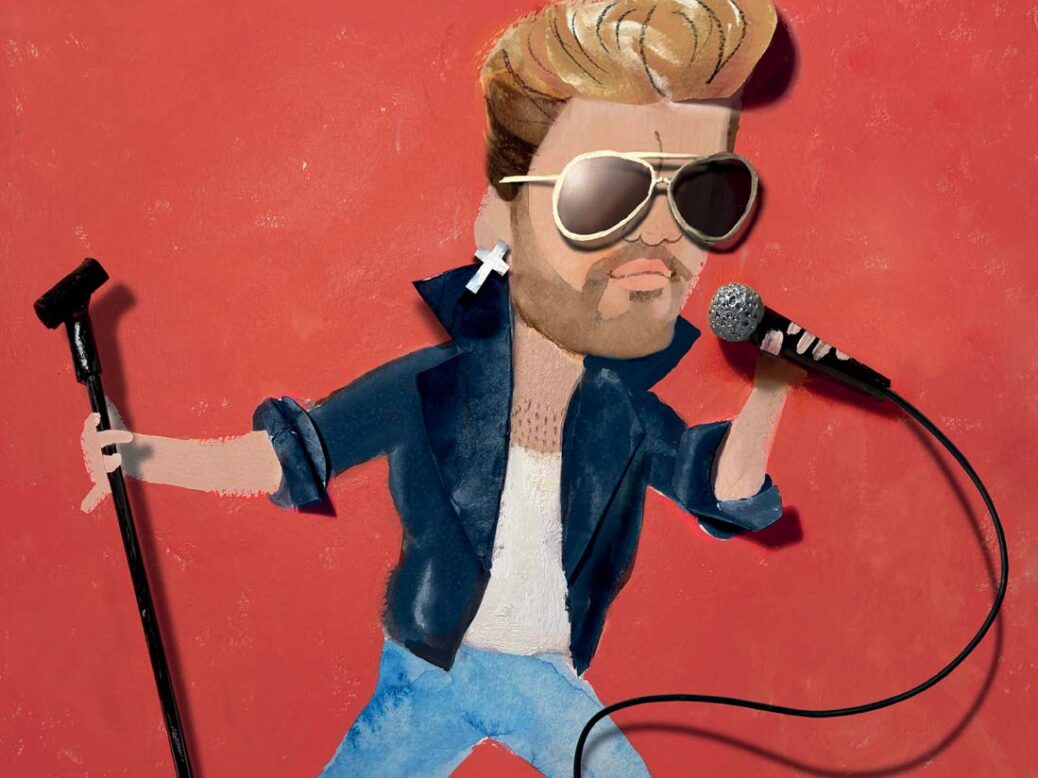
In the world of pop counterfactuals – what if Lennon hadn’t moved to New York? What if Buddy Holly had missed that plane? – there is none more poignant than the vision at the end of Sathnam Sanghera’s new book, in which George Michael headlines Glastonbury with his two dozen hits, free from drugs, a venerated gay elder at peace with his own back catalogue.
This is the kind of fantasy that superfans torment themselves with, and Sanghera – the very same who writes books about the British empire – is certainly one of those. It is powerful because George Michael would have been so at home in 2026, in a society that doesn’t “out” its pop stars by posing undercover to catch them in public toilets. Michael was made for this era: deeply self-analytical, often self-obsessed, he was both vain and vulnerable, the perfect combination of hipster and nerd. He was funny, eloquent and full of righteous ire (he sued his record label twice). In the short space of time he was on Twitter, he used it well, revealing that Rebekah Brooks told him the tabloids got their information from the police and not the public, and calling David Cameron “the most cowardly PM we’ve seen for decades”. At an event for Sanghera’s book in London, fans stood up and speculated about what he’d be doing now. “He would be bitterly disappointed in Keir Starmer,” said one. “He’d be campaigning against the war in Iran,” said Sathnam.
In the months before Michael’s death on Christmas Day in 2016, I tried many times to get him to do an interview with me. I wrote to Connie Filippello, his old-school PR, who always replied with a personal touch, but would never have considered the kind of “serious” piece I wanted to write: in those days, like Elton John, when George occasionally spoke, it was to the same tabloids that made his life a misery. In truth, he was no longer available for much because, as Sanghera puts it, he “did away with himself slowly, over more than a decade, in plain sight… If some people were surprised by his death it was largely because, in an echo of Donald Trump’s approach to policymaking, the concentration of the drama was so all-consuming it was hard to take things in.” Michael’s outrageous litany of accidents often revolved around his car: in seven separate incidents, he was caught either driving erratically, or falling asleep at the wheel – there was also the time he fell out of a moving Range Rover near St Albans, in 2013. At times, he was smoking crack, and at one point he was smoking 25 spliffs a day. Although it was not that long ago in the scheme of things, it was still the age in which the papers laughed at celebrities’ mishaps, and watched their lives unravel for sport.
Sanghera was planning a book about Israel and Palestine until his friend, the novelist Elizabeth Day, suggested he take a break and write one about something that made him happy instead. His interest in George Michael is, in one sense, another arm of his academic concerns: as Jeremy Deller’s viral poster of Wham! made clear (“Thank God for immigrants!”), the band would not have existed without the British empire – George’s father was Greek Cypriot (Cyprus was part of the empire until 1960) and Andrew Ridgeley’s came over from Egypt because of the Suez crisis of 1956. The young duo’s legendary fashion sense reminds Sanghera of the loud, brash clothing of immigrant dads making their mark in 1950s Britain.
George Michael has a large following among the second-generation South Asian community, which Sanghera puts down to the combination of immigrant experience and open-hearted expression: lots of young Asian men in the 1990s grew a George Michael beard. Sanghera was raised, he once said, in a Punjabi world “where men had no feelings” – and Michael was “the most glamorous person in the world” to him. As a young straight man, his obsession with the singer was a source of mockery to his friends, but he bore it as he bore his other differences. There was no tribute concert when his hero died, no communal public mourning – but the fan base was and is devoted. I recall the shrine outside Michael’s home in Highgate Village, his Range Rover stuffed full of flowers. Though at one point he was nearly as famous as Madonna and Prince, he had no major security in place. In 2004, a fan was found living under his floorboards; he only realised she was there when he heard her calling his name.
Sanghera had no access to Michael’s family and avoids speculation over the exact cause of his death by pointing out that the death took the best part of a decade. He picks several aspects – control freak, scapegoat, genius naif – and moves through them in a way that is somehow chronological. His real gift to Michael is taking the music seriously, which never really happened in his lifetime. He listens to “Last Christmas” cover versions to try to work out why no one, not even Taylor Swift, can produce a convincing one – it comes down to the voice, a flawless instrument infused with a unique melancholy.
In 1983, Wham! flew to Ibiza to film the video for “Club Tropicana” at the Pikes Hotel in the Benimussa Hills. Michael, then 19, had a fling with the married club owner Tony Pike, 30 years his senior (he is in the video in a straw hat and moustache). The next day, he felt such certainty about his sexuality that he called Andrew Ridgeley and their bandmate Shirlie Holliman into his room to tell them he was gay. At this crossroads, the two teenage friends persuaded him not to come out because they were afraid of his father’s reaction. “The three of us were so close at the time but I’d really, really asked the wrong people,” he later said. He wrote his own counterfactual, “A Different Corner”, the same year: “I’d say love was a magical thing/I’d say love would keep us from pain/Had I been there.”
It is still astonishing to think how much silence there was around sexuality in the 1980s. In the pop world, only Jimmy Somerville and Andy Bell were openly gay. Elton was married. A lot of people thought Boy George just liked dressing up. Sanghera celebrates the fact that millions of straight George Michael fans “went into the heart of a gay man” without knowing it. But a gay friend tells me he needed Michael to be fully out before he could connect to the music – then did so backwards in a retrospective evaluation. The happy-sad songs vibrate with brand new meaning this way. “Freedom”, “Father Figure”, “Jesus to a Child” – this being about the death of his lover Anselmo Feleppa from Aids (at the time, people said the song was about his mother). His sleekest song, “Spinning the Wheel”, imagines the Russian roulette of living with a promiscuous partner at the height of the HIV crisis: “One of these days you’re gonna bring it back home to me.”
As part of his research, Sanghera gamely attended the George Michael Sexual Freedom Party in the long grass at Hampstead Heath, where he met and interviewed a young man who had previously worked for the Met Police, before he was arrested for exposing himself in the park and lost the job he loved. The man took deep solace in the fact that George Michael went through a similar thing in Los Angeles, in April 1998, which forced his coming out. But Michael never grew into the role of gay icon – he never had the chance. Who knows, perhaps he wouldn’t have wanted to be one. He once said, “I don’t really see myself as a role model for anyone, unless gay youths are looking for advice on how to get arrested, I suppose.”
Tonight the Music Seems So Loud: The Meaning of George Michael
Sathnam Sanghera
Picador, 299pp, £22
Purchasing a book may earn the NS a commission from Bookshop.org, who support independent bookshops
[Further reading: England is in a state]
Content from our partners


Related
This article appears in the 17 Jun 2026 issue of the New Statesman, The Race