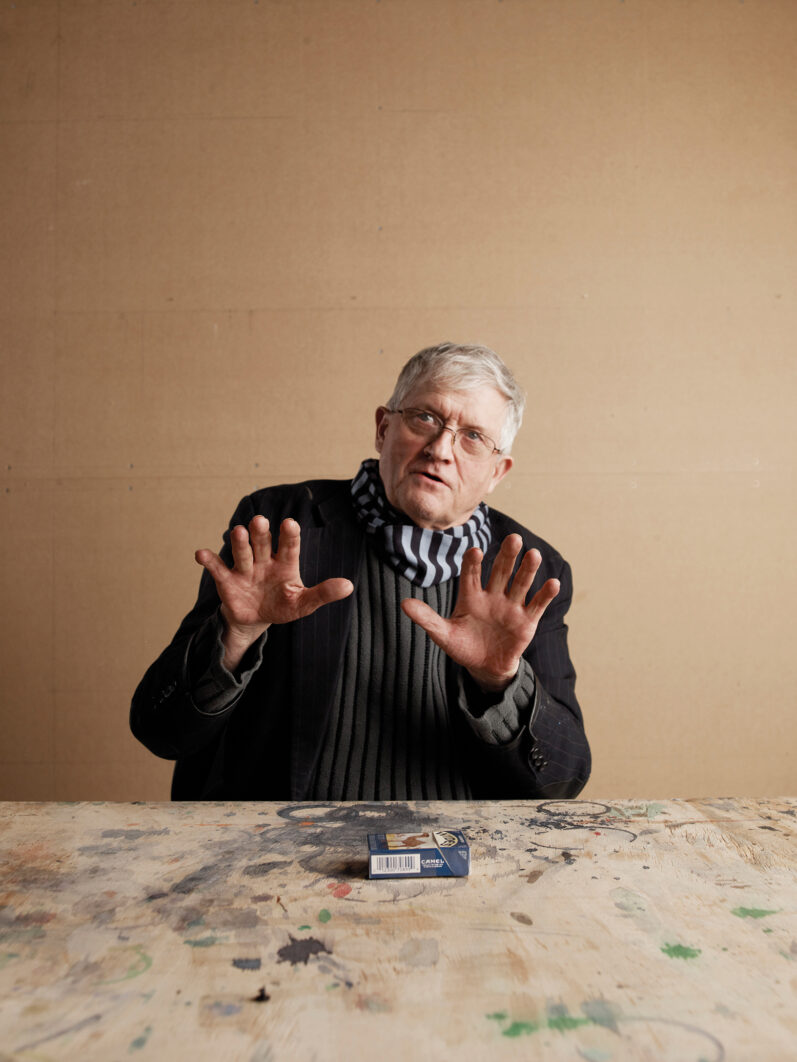
David Hockney was the most recognisable and beloved British artist of the late 20th and early 21st centuries. Nevertheless, he was acutely aware that his fame was double-edged. “I am very fed up with being a very public ‘art celebrity’,” he once said, “and I must be serious. I think it’s beginning to affect my own sanity.” Much of his career was spent grappling with this disconnect but whatever he made, however “serious” he tried to be, the public – here and internationally – loved him for it. Even at his most cerebral, Hockney was an accessible artist who seduced through colour and scale, as well as one who had an eye for composition and subjects that were unthreatening. His aesthetic – big glasses, vivid clothes and blond hair (which he adopted in 1961 from an American advertisement for Lady Clairol: “Is it true that blondes have more fun?”) – had been assumed in his student days. It was a winning look that contrasted with his no-nonsense Yorkshire accent.
For all his modest beginnings as the son of a Bradford accountant, Hockney’s lament about art celebrity came from a position of privilege. By 1962, the year he graduated from the Royal College of Art, he was already a face in that decade of faces, photographed by Antony Armstrong-Jones for the new Sunday Times colour magazine. His was a career without the struggle for recognition: exhibition requests and acquiring a dealer – and not just any dealer but the dealer, John Kasmin – happened early. For 64 years he could work safe in the knowledge of both financial security and an eager public.
Nevertheless, his seriousness was always present. The early part of his career coincided with the rise of abstract and conceptual art and, after a brief foray into abstraction (a genre he quickly abandoned: it “can’t go anywhere”), he stuck doggedly with figurative art in defiance of the “painting is dead” mantra of the times. Still, he found ways to keep the tradition of painting fresh. Perhaps his most famous picture, A Bigger Splash (1967), for example, is a hybrid work, both realistic – a dream of blue Californian sky and a swimming pool, an American modernist house, a thin line of vegetation and a single unoccupied chair – and theoretical, with its fascination with blocks of undifferentiated colour, grids, subtle tonal contrasts and that messy, watery splash that he said took him two weeks to perfect. It is a serious painting.
Other pictures showed his engagement with art history too. Mr and Mrs Clark and Percy (1971), a double portrait of the fashion designer Ossie Clark and his wife, Celia Birtwell, updates both Thomas Gainsborough’s Mr and Mrs Andrews (circa 1750) and the conversation pieces of the 18th century. Another double portrait, of Christopher Isherwood and Don Bachardy (1968) – which sold last year for more than $44m – contains in the foreground a still life of a bowl of fruit that is an immaculate homage to the likes of Caravaggio, Jean Siméon Chardin and the Dutch painters of the early 17th century.
For all the crisp modernity of his images, Hockney worked looking backwards as well as forwards. Indeed, Secret Knowledge (2006), his provocative book suggesting the widespread use of optical aids by old masters such as Vermeer, proved a fox in the hen coop of art historical orthodoxy but showed how deeply and clear-headedly he thought about the craft of painting.
However, modernity was always present in his art. Having noted that artists had always used emerging technologies, he was true to his observation. Fax machines, Polaroids, photocopies, high-resolution cameras and his iPad were tools every bit as important to him as pencils and brushes, although the results were less accomplished. This experimental spirit extended to his media too, and he made not just paintings and drawings but prints, collages, opera and ballet sets, digital installations and even a 90-metre frieze, A Year in Normandie, both a nod to the Bayeux Tapestry (which he strongly opposed being moved for exhibition in London) and to the landscape around the French home where he sat out the pandemic.
This artistic curiosity was ingrained: a wide circle of friends and acquaintances would awake each morning to find a new iPad drawing by him in their inboxes. Right to the end of his life he kept making art – suites of portraits and still lifes in which he played with perspective and perception. This was a compulsion – like Picasso, he simply couldn’t stop himself – and a mission too: “I am keeping modernism alive with my ideas about seeing and depicting,” he once declared.
Last year a huge, 400-work retrospective of his career was held at the Fondation Louis Vuitton in Paris, and what it showed most clearly was that Hockney was himself composed of several artists. The Hockney of the 1970s was a preternaturally gifted draughtsman, capable of drawing portraits of extraordinary finesse; his paintings of swimming pools and sunshine purveyed the Californian dream with an intense stylishness (“Venice, California, is more beautiful than Venice, Italy,” he once said); from the late 1970s he became a colourist, previously “colour hadn’t seemed that important to me in painting”; his landscapes – of Mulholland Drive, of the Grand Canyon, of the Yorkshire Wolds – brought a new, oversize scale and super-saturated tonality to view and nature painting; while the pictures and photographic works he made around Bridlington from the early 2000s show a commitment to a particular place under the changing of the seasons that calls to mind John Constable’s relationship with the Stour Valley.
And running throughout them all was an urge to preserve the likeness of lovers and friends. These he made entirely for himself: he painted only one portrait to commission, that of David Webster, former general administrator of the Royal Opera House, made in 1971 and controversially sold for £11m (more than £12.8m with fees) in 2020 to raise funds for the institution.
All of Hockney’s art was the result of both his curiosity and his indefatigability, the latter a trait identified back in the 1970s by a friend: “He’s constantly thinking that he hasn’t worked hard enough.” Consequently images poured from him, to the delight of the public, who responded in huge numbers (more than 600,000 people visited the Royal Academy in 2012 to see his exhibition there), drawn by the mindfulness of his pictures, with their uncomplicated joyousness and pleasure in the world – whether that be Yorkshire hawthorn hedges foaming with blossom (like “Champagne poured over everything”) or rain falling in his Normandy garden.
Hockney not only made art the public could relate to but he was also a man they could relate to, his no-nonsense approach pricking the balloon of the highfalutin. In the 1970s, Hockney was invited by Baron Philippe de Rothschild to design a label for his latest vintage; over dinner at the château Hockney leaned across to his host and said: “I must tell you, Baron, that this is the best home-made wine I’ve ever drunk.” Hockney, although he did grand cru art too, was in turn responsible for some of the modern era’s best home-made painting.
[Further reading: David Hockney was a swirling, explosive star]
Content from our partners


Related