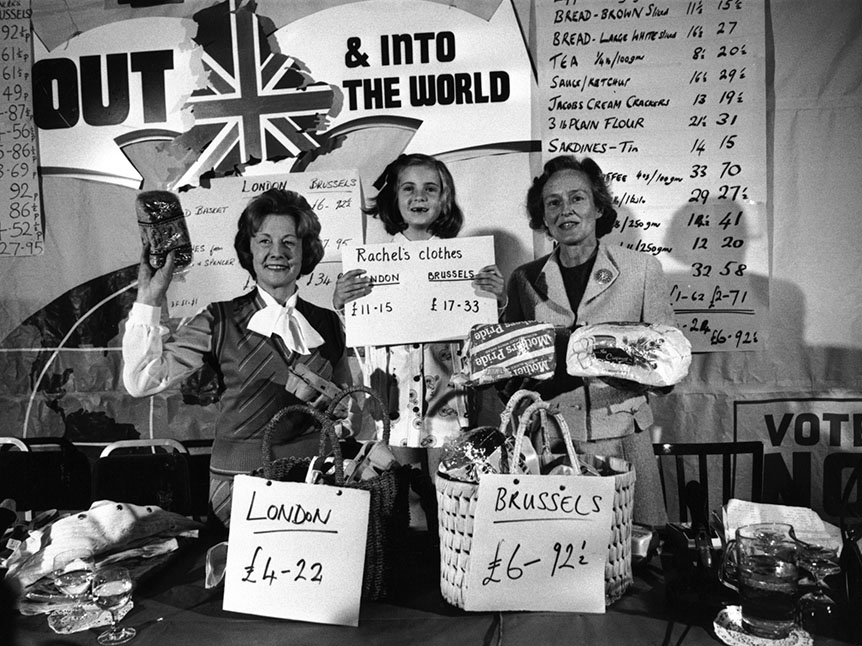
In May 1975, the New Statesman invited leading writers and thinkers to give their views on the upcoming referendum on the Common Market. The vote, held on 5 June, would deliver a definitive yes to the UK remaining in the European Communities (EC), with 67 per cent in favour. Here is a selection of perspectives from the article.
AJ Ayer, philosopher
I have always been in favour of our joining the European Community because I see it as a step in the opposite direction to the ominous contemporary growth of nationalism. The argument that our membership prevents our government from effecting the internal changes that it thinks desirable does not seem to me to be sustained by any present evidence. Nor do I think that our going back on our agreement at this stage would be favourable either to our political or to our economic standing.
Alasdair MacIntyre, philosopher
Retreat from traumatic reality into self-indulgent fantasy is an increasingly familiar characteristic of our politics. The debate on the Common Market is clearly just one more psychodrama. For Britain the issue of membership is not crucial. There are no decisive economic arguments on either side; hence the substitution of speculative guessing games by too many economists. Politically the paralysed inertia of British government makes it apparently invulnerable to all change, harmful or beneficial. Certainly the minuscule institutions of the Market are unable to be an agency of radical change. But when economic reality is about to thrust painful and costing choices on the inmates of the parliamentary asylum, a certain brouhaha about the Market serves to direct attention from that reality for a little longer. How to vote? It would be splendid if future historians were able to record that they held a referendum and nobody came.
AJP Taylor, historian
I do not like the division of Europe and am against anything that cuts us off from the peoples of eastern Europe who share our European heritage. I do not like the advocates of EEC and can imagine no circumstances where I should be happy in the company of Heath, Thatcher and Roy Jenkins. I have seen no clear figures showing that we shall gain by staying in the EC. I have also seen no clear figures showing that we shall gain if we come out. But if I vote at all in the referendum I shall vote “no”. Like Clemenceau I am always contre.
Margaret Drabble, author
I shall vote “yes”, in reaction against (a) demoralising vacillation; (b) the curious passion that the left has developed for sovereignty, nationalism and the rights of the Commonwealth; (c) the meaningless xenophobia which is one of the most dangerous and uncontrollable weapons of politics.
More positively, I do have some faint hope of an enlightened, united and democratic Europe playing an enlightened role in world affairs. I don’t see why a united Europe should be nothing but a large commercial capitalist trading block: its individual members all have made contributions to welfare and civilised democracy, and I hope we can take the best from each other, not the worst. The one certainty is that in this situation no one is certain, and we have to act and choose by emotion, rather than reason. Also, I simply don’t believe that getting out wouldn’t create an appalling mess. Of course it would.
Peter Nichols, playwright
I shall vote “out”. I live near the Dover Road and certainly don’t want any more Italian container trucks bringing another load of fold-up bicycles that no one will be able to ride because of all the container trucks. If that is the kind of benefit we get from membership, we are better off becoming a fifth-rate power.
This is an edited version of the original symposium.
[Further reading: ]
Content from our partners